“No man ever steps in the same river twice”
Heraclitus
Twenty three years ago, the Court of Appeal gave its controversial judgment in Three Rivers (No 5) [2003] QB 1556 concerning the scope of legal advice privilege. The correctness of the decision has been doubted in two subsequent Court of Appeal decisions, but the Court of Appeal is bound to follow it. To reverse it would require an appeal to the UK Supreme Court. In a recent first instance case Aabar Holdings SARL v Glencore PLC [2026] EWHC 877 (Comm) the defendant’s lawyers boldly declared that they had approached disclosure on the basis that Three Rivers No.5 was wrongly decided and had been treating legal advice privilege as applying more widely than was held in that judgment. They subsequently rowed back on that claim, perhaps lacking the appetite for pursuing the matter to the UK Supreme Court. However, there followed a dispute and a careful judgment about exactly what Three Rivers (No. 5) decided.
Three Rivers (No 5)
Three Rivers (No 5) arose out of the collapse in 1991 of the Bank of Credit and Commerce International (“BCCI”), causing its depositors substantial losses. The Bank of England (the “Bank”) has a supervisory role in relation to banks carrying on business in the UK. An inquiry was conducted into the Bank’s supervision of BCCI by Bingham LJ (as he then was). The Bank appointed three of its own officials, known as the “Bingham Inquiry Unit” (“BIU”), to deal with all communications between the Bank and the inquiry. The BIU’s communications with the inquiry were the subject of extensive advice from the Bank’s lawyers, Freshfields.
The liquidators and creditors of BCCI subsequently brought proceedings against the Bank seeking to recover their losses, alleging the Bank had committed the tort of misfeasance in public office in failing properly to supervise BCCI. As is in most English litigation, each party was required to search for documents relevant to the issues in the proceedings and provide a copy of each such document to the other party, unless the document was ‘privileged’.
The Bank claimed it had the right to withhold, on grounds of legal professional privilege, a large number of documents which had been brought into existence by employees of the Bank for the purposes of the Bingham Inquiry. It was common ground that documents emanating from or prepared by independent third parties and then passed to Freshfields were not privileged. It was the status of documents prepared by Bank employees that was in issue.
English law recognises two forms of legal professional privilege. Legal advice privilege covers communications between lawyers and their clients for the purpose of seeking or giving legal advice. Litigation privilege covers documents brought into being for the purposes of actual or contemplated litigation. The documents prepared by the Bank’s employees had been brought into being for the purposes of the Bingham Inquiry. If the Bingham Inquiry had been ‘litigation’ then all the documents in question would have been privileged and there would have been no issue. However, in Re L [1997] AC 16, their Lordships had held that litigation privilege could not be claimed in a report prepared for use in ‘non-adversarial’ proceedings. Per Lord Scott in Three Rivers (No.5):
“The Bingham Inquiry could not have been described as adversarial. It was, as inquiries invariably are, an inquisitorial proceeding. It was no doubt with in re L in mind that the Bank did not claim that the documents of which disclosure was being sought were entitled to litigation privilege.”
Instead, the Bank sought to claim privilege in the documents as having been prepared for the dominant purpose of obtaining or recording legal advice from Freshfields or counsel. As against that, the claimants submitted that only communications between solicitor and client, and evidence of the content of such communications, were privileged. They suggested that preparatory materials obtained before such communications, even if (i) prepared for the dominant purpose of being shown to a client’s solicitor, (ii) prepared at the solicitor’s request, and (iii) subsequently sent to the solicitor, did not attract privilege.
The Court of Appeal accepted this and held that the only documents for which legal professional privilege could be claimed were communications between the BIU and Freshfields seeking or giving legal advice. The BIU, and no one else, was to be treated as Freshfields’ “client” for privilege purposes. A document produced for the purposes of obtaining legal advice, but by an employee outside the BIU, stood in the same position as information provided by an independent third party. Permission to appeal to the House of Lords on that point was refused.
The effect of Three Rivers (No 5)
Following Three Rivers (No 5), when the client is a corporation, it will only be the small identifiable group of people who are actually charged or tasked by the corporation with seeking advice on its behalf – referred to in some later cases as the “client group” – who can have protected communications with the corporation’s lawyers (internal or external) under the ‘advice’ head of privilege, as illustrated below (the green box indicating privilege, with the red boxes denoting non-privileged communications):
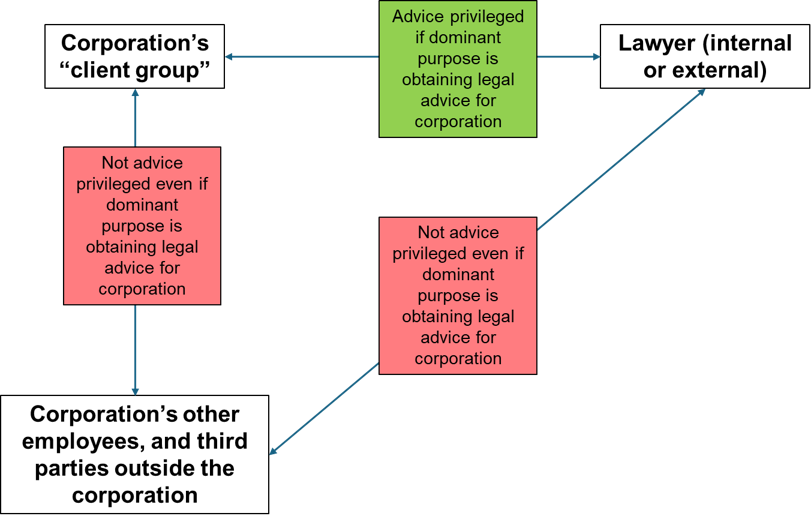
Preparatory communications between the client group and other employees of the corporation, even if (i) intended for submission to the corporation’s lawyers or prepared at the request of the client group or its lawyers for use in seeking legal advice, and (ii) actually submitted to the corporation’s lawyers, are not privileged. Direct communications between the legal advisers and current or former employees of the corporation outside of the client group that seek or convey factual information needed by the legal advisers to enable them to advise the corporation are also not privileged, even where those employees are expressly authorised by the corporation to so communicate.
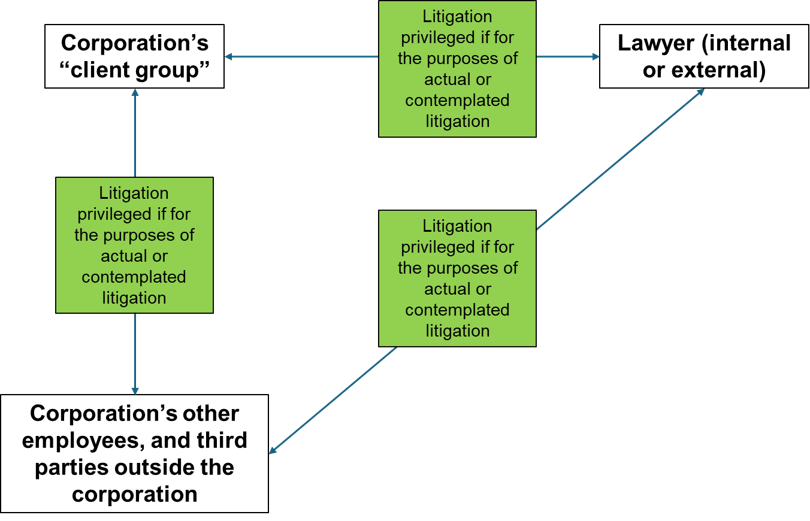
It is worth stressing that, once litigation is in contemplation, the position changes radically and the concept of the limited client group no longer operates to restrict privilege, as shown below (green boxes indicating privilege):
Criticism of Three Rivers (No. 5) by the Court of Appeal
In Serious Fraud Office v Eurasian Natural Resources Corp. Ltd [2018] EWCA Civ 2006, the defendant ENRC asserted that certain documents generated during investigations into its activities by its solicitors and forensic accountants were the subject of legal advice privilege and/or litigation privilege. These documents related to fraudulent practices allegedly committed in Kazakhstan and Africa, which had been notified to ENRC by a whistle-blower, and included notes made by ENRC’s outside solicitors of some 184 interviews (including with its current and former employees). The Court of Appeal held the documents were brought into existence for the dominant purpose of resisting or avoiding contemplated criminal proceedings against ENRC, so were litigation privileged.
The question of whether they were (also) ‘advice privileged’ was thus rendered less important, but the Court of Appeal did consider that, following Three Rivers (No. 5), the documents were not privileged:
“127. ... large corporations need, as much as small corporations and individuals, to seek and obtain legal advice without fear of intrusion. If legal advice privilege is confined to communications passing between the lawyer and the “client” (in the sense of the instructing individual or those employees of a company authorised to seek and receive legal advice on its behalf), this presents no problem for individuals and many small businesses, since the information about the case will normally be obtained by the lawyer from the individual or board members of the small corporation. That was the position in most of the 19th century cases. In the modern world, however, we have to cater for legal advice sought by large national corporations and indeed multinational ones. In such cases, the information upon which legal advice is sought is unlikely to be in the hands of the main board or those it appoints to seek and receive legal advice. If a multi-national corporation cannot ask its lawyers to obtain the information it needs to advise that corporation from the corporation’s employees with relevant first-hand knowledge under the protection of legal advice privilege, that corporation will be in a less advantageous position than a smaller entity seeking such advice. In our view, at least, whatever the rule is, it should be equally applicable to all clients, whatever their size or reach. Moreover, it is not always an answer to say that the relevant subsidiary can seek the necessary legal advice and, therefore, ask its own lawyers to secure the necessary information with the protection of legal advice privilege. In a case such as the present, there may be issues between group companies that make it desirable for the parent company to be able to procure the information necessary to obtain its own legal advice.”
“130. If, therefore, it had been open to us to depart from Three Rivers (No. 5) , we would have been in favour of doing so. For the reasons we have given, however, we do not think that it is open to us, so it is a matter that will have to be considered again by the Supreme Court in this or an appropriate future case.”
The Court of Appeal in R (Jet2.com Ltd) v CAA [2020] EWCA Civ 35 agreed. The CAA (the UK aviation industry regulator) issued a press release criticising Jet2 for refusing to participate in a scheme for resolving consumer complaints which the CAA had promoted and which almost all similar airlines had agreed to. Jet2 wrote to the CAA objecting to the content of the press release. The CAA responded in a letter of 1 February 2018, which the CAA also supplied to The Daily Mail, prompting articles critical of Jet2 (“In a leaked letter Jet2 Boss reveals why it won’t join new flight delay compensation scheme – too many customers will win their money back!”) repeating criticisms of Jet2 from the press release and 1 February 2018 letter and generally adopting the CAA stance. Jet2 brought judicial review proceedings alleging that the CAA either had no power to make the publications or alternatively, if it had such power, had exercised it for unauthorised and improper purposes namely to damage Jet2’s trading interests, to punish Jet2 for its decision not to join the scheme and to put pressure on Jet2 to join the voluntary scheme.
Jet2 sought disclosure of all drafts of the 1 February 2018 letter and all records of any discussions of those drafts. The CAA disclosed some internal correspondence showing a CAA director instructing a colleague to “develop a narrative around Jet2 ... References to their billionaire chairman might not go amiss ... attack dogs please” and a first draft of the letter (“I wouldn’t quite call it ‘attack dog’ style. More of a cranky alpaca”). There were further drafts and internal discussions, but two in-house lawyers had been involved in those discussions and had given advice in relation to the various drafts, and so the CAA claimed privilege in all the communications to which the lawyers had been party. For several of those communications the CAA accepted that the dominant purpose of the communication had not been to give or obtain legal advice. The case principally concerned the question of whether, to be privileged, the communication had to have been for the dominant purpose of giving or obtaining legal advice (answer: yes).
However, the Court of Appeal discussed in passing Three Rivers (No. 5):
“57. ... I respectfully doubt both the analysis and conclusion of this court in Three Rivers (No 5) on this issue; and, had it been in this court's power, I too would be disinclined to follow it.
58. But, as I have indicated,, we do not have that power. ...
59. However, the facts of this case – and the issue to which they give rise – are significantly different from those in Three Rivers (No 5) ... The relevant lawyers in this case were in-house; and Morris J found that the in-house lawyers were involved in the internal correspondence qua lawyers rather than merely as executives providing commercial advice ... The relevant non-lawyers were all relatively senior executives. There appears to be no evidence suggesting that any of those involved in the relevant internal correspondence did not have the ability to seek legal advice from those lawyers, or that, for these purposes, they were not "an emanation of the client". It seems to me that, on the evidence, in this case each of the non-lawyers involved fell within the scope of "client" so far as the lawyers involved were concerned.”
What these cases illustrate is that, for all the criticism of Three Rivers (No. 5), the ‘real world’ effect is limited:
- Internal investigations into potential wrongdoing by the corporation will often have been conducted in contemplation of litigation, so that the documents generated will attract litigation privilege as in SFO v ENRC. The situation in Three Rivers – where a corporation is investigating its own wrongdoing, not with a view to potential litigation but only for some other purpose, like a public inquiry, will be rarer.
- In other situations besides internal investigations, the people communicating with the lawyers for the purpose of seeking and receiving legal advice will very often be people who can properly be characterised as falling within the ‘client group’ as in Jet 2.
Lord Scott’s shorthand distinction between “adversarial” and “inquisitorial” proceedings as the dividing line beyond which litigation privilege applies is with respect potentially misleading. Much litigation in other jurisdictions can be described as “inquisitorial”, in the sense that the decision makers perform an investigative, evidence gathering, role rather than just consider the competing evidence and submissions presented to them. The better distinction is between proceedings before a tribunal with the power to impose a penalty or determine liability (like a court) and proceedings before public enquiries (like the Bingham Inquiry) which have no such powers.
Aabar Holdings v Glencore
Glencore PLC (“Glencore”) is a global natural resources company with market capitalisation (at time of writing) of around £66 billion. Its shares were the subject of an Initial Public Offering (“IPO”) in 2011. Certain of its subsidiaries are alleged (and, in some cases, admit) to various misconduct in Africa and South America, and have admitted to oil price manipulation in relation to the fuel oil market at certain US ports. This misconduct has (so far) led to the confiscation of funds, disgorgement and the imposition of fines against Glencore totaling approximately US$1.4 billion.
Several claimants are pursuing claims against Glencore and certain of its former directors in the Commercial Court, claiming that documents issued by Glencore PLC (such as the prospectus in respect of the initial IPO and periodic company reports) contained misstatements, or omitted to disclose things they should have disclosed, regarding this misconduct, and that the claimants have incurred losses on their investments in Glencore as a result.
Clifford Chance, acting for Glencore in those proceedings, told the claimants they had approached disclosure on the basis that the Court of Appeal decision in Three Rivers (No. 5) [2003] QB 1556 was wrongly decided inasmuch as that decision is understood as standing for the proposition that “legal advice privilege attaches only to communications passing between a corporation’s lawyers and employee(s) of the corporation who have been tasked with seeking and receiving such advice on behalf of the client”, and that they had been treating legal advice privilege as instead applying more widely to “all communications made for the dominant purpose of seeking or receiving legal advice”.
The claimants objected that this was inconsistent with Three Rivers (No. 5) in two ways: first, in treating every employee as “the client” and second, in not confining the privilege to communications between client and lawyer (or those that disclosed legal advice). Glencore then ceased to assert privilege on the basis that Three Rivers (No. 5) was wrongly decided, and abandoned the contention that every employee should be treated as “the client”. Instead, it presented a somewhat narrower claim: that intra client communications (i.e. communications between people in the client group) are privileged if for the dominant purpose of seeking legal advice.
In his judgment Picken J presents a careful analysis of Three Rivers (No. 5), identifying that the reasoning is addressed to non-client documents – i.e. documents produced by people who were outside the BIU:
“24. It is right to acknowledge that, ... the evidence ... which was before Tomlinson J, at first instance in Three Rivers (No 5), suggests that some of the documents with which Three Rivers (No 5) was concerned were intra-client documents in the sense that they were internal to the BIU; indeed, it appears that the order that Tomlinson J made (as upheld by the Court of Appeal) includes this category of documents. However, there was no argument either before Tomlinson J or the Court of Appeal addressing intra-client documents, indicating that none of the parties had such documents as their focus. This, no doubt, explains why neither Tomlinson J nor the Court of Appeal addressed the issue of intra-client documents. Their reasoning was silent on the point that is now before the Court. In the circumstances and put simply, it would be wrong now to take it that Three Rivers (No 5) is authority in respect of intra-client documents merely because the order made by Tomlinson J (and upheld by the Court of Appeal) included such documents and notwithstanding that nowhere in either Tomlinson J or Longmore LJ's judgments was that category of documentation specifically addressed.”
Having concluded that Three River (No. 5) did not decide the point, Picken J proceeded to consider whether intra-client communications for the dominant purpose of seeking legal advice, but to which lawyers are not party, should be protected by privilege.
The judge drew an analogy with a lawyer’s working papers. Lawyer’s notes are privileged, even though they are not communicated to the client. A client’s preparatory work is analogous. The Judge cited with agreement a passage in Thanki: “the protection must extend to some documents which are anterior or preparatory to the actual lawyer-client communication. This would most obviously apply to drafts of actual communications, such as a draft letter to the client or the lawyer (as to which there can be no serious dispute that privilege would apply). ... Where a document has been prepared ... by the client for the purpose of communicating it to his solicitor it must stand on the same footing as an actual letter, for instance rough notes or memoranda for this purpose.”.
The judge went further:
“57. Nor would it make sense for legal advice privilege not to apply to intra-client documents whose dominant purpose is to identify facts that the client proposes to communicate to a lawyer for the purpose of seeking legal advice, but where the document itself is not intended to be sent to the lawyer. An example might be a client, the day before he or she is due to meet his lawyer for the first time, writing himself or herself a memorandum with notes for the meeting. Another example might be one member of the client group, who will not be attending the meeting with the lawyer, emailing another member of the client group with information or thoughts in preparation for the meeting. ... there can be no distinction in principle between an intra-client document which is itself intended to be communicated to a lawyer and an intra-client document which contains information that is intended to be communicated to a lawyer but the document itself is not intended to be sent”.
It is hard to disagree.
Conclusion
Aabar v Glencore is a first instance decision and it is unclear whether there is any appeal contemplated, but the analysis is very convincing as to why communications within the ‘client group’ to which lawyers are not party will be advice privileged if prepared for the dominant purpose of seeking legal advice.
The wider practical significance of the decision is probably limited. Even in the context of the case itself, the significance is unclear. The misconduct of Glencore’s subsidiaries clearly had the potential to result in criminal or regulatory sanctions, and so would have expected many of Glencore’s internal communications about the matter, and ‘fact gathering’ type communications where the parent is seeking to ascertain what its subsidiaries have done, and what the group’s exposure is, would be litigation privileged, so that it would not matter whether the communications were within or outside the client group. The judgment does not say how many documents in the case were (i) communications within the client group which (ii) were being withheld on the basis of advice privilege as distinct from litigation privilege.
What the judgment does reveal is that, when Clifford Chance abandoned its position that Three Rivers (No. 5) was wrongly decided, and disclosed documents produced by people outside the client group for the purpose of obtaining legal advice, that only resulted in 885 additional documents being produced, which seems very modest for a case of this nature and scale. That might indicate that the amount of material for which advice privilege was claimed rather than litigation privilege is modest. One might also infer that the 885 documents produced by people outside the client group for the purpose of obtaining legal advice probably weren’t that incendiary, since Glencore seems to have been unwilling to pursue a campaign to try to get Three Rivers (No. 5) reversed in order to protect them from disclosure.
Some practical advice for in-house lawyers and their internal clients when seeking or giving advice, or providing or gathering information for the purpose of seeking or giving legal advice might be:
- Consider formally defining and identifying a generous client group – all the people who are charged or tasked by the corporation with seeking legal advice on its behalf.
- Keep communications about legal matters with persons outside the ‘client group’ to a minimum.
- Where intra-client communications do have a legal purpose, there is some value in ensuring that is understood and recorded. Rather than “see attached” try “see attached results of my preliminary investigation into the matter for the purposes of your meeting with the lawyers ...”.
- Consider and be alert to any potential for litigation to arise out of the matter in question and, if there is the potential for litigation, ensure that is reflected in the correspondence. If the matter does later result in litigation, this will make it easier to identify a point in time from which broader litigation privilege can be asserted, and potentially permit that to be done from an earlier juncture, rather than being forced to rely on advice privilege limited to the client group.