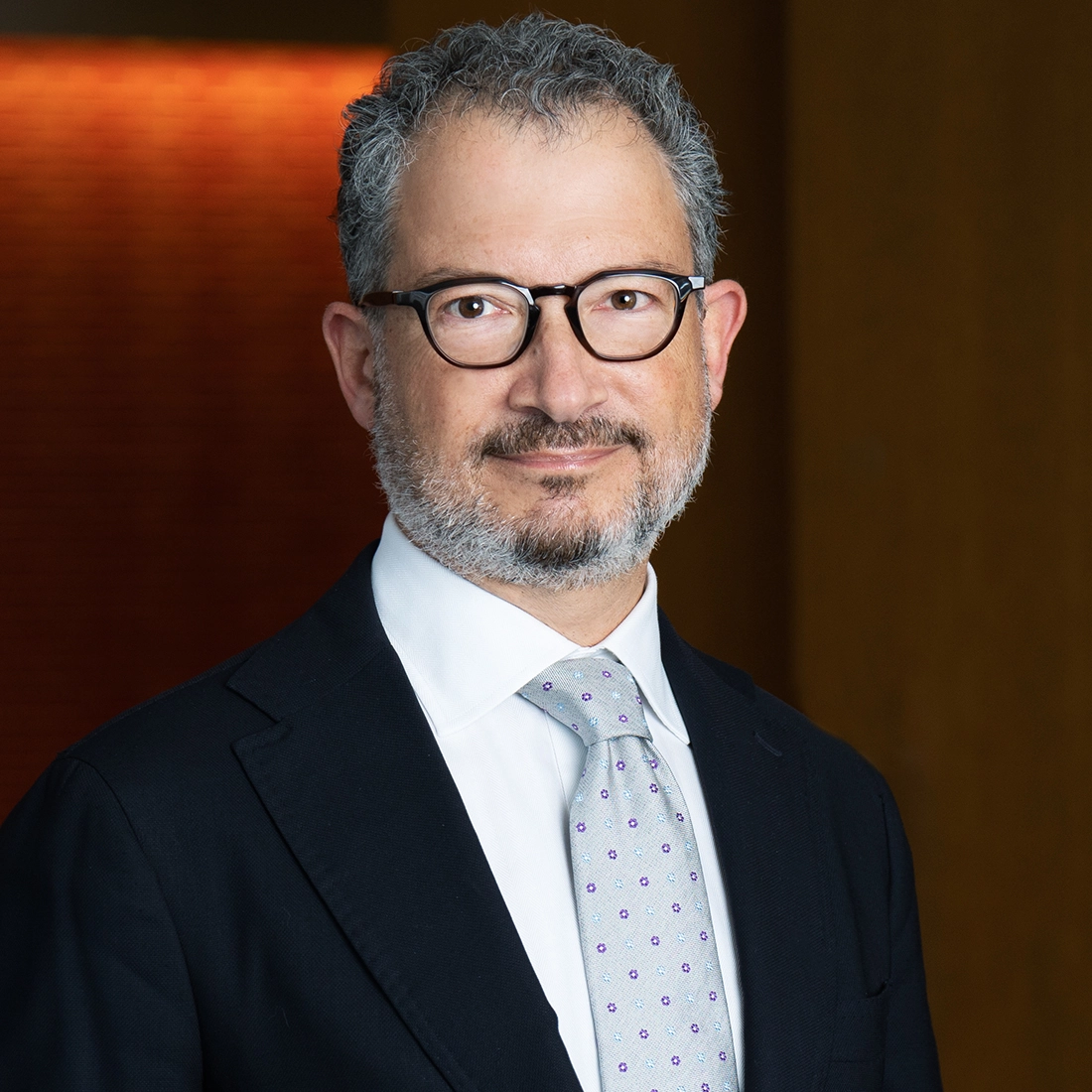
Giorgio Bovenzi
Biography
Giorgio Bovenzi leads our Global Credit Risk Management practice and advises clients on commercial, banking, and insolvency law in the context of cross-border financial market transactions. A bankruptcy lawyer by training, Giorgio’s practice has dealt with the insolvency laws of a large number of jurisdictions worldwide and with the implementation of arrangements designed to mitigate credit risk in multi-jurisdictional settings. In recent years his practice has expanded to include digital assets and their credit and regulatory implications. The value of Giorgio’s counsel derives from 30 years of experience in insolvency, credit, banking, regulatory, and derivatives law in multiple jurisdictions around the world. Prior to joining the firm in 2019, he practiced at Skadden, Davis Polk, and Dentons.
Chambers USA notes that Giorgio “is particularly recommended for his extensive knowledge of global banking laws” and cites a client who describes him as “a very focused lawyer who's very highly regarded by financial institutions.” Other clients state that Giorgio "is very good to work with and excellent at finding solutions” and offers a “good depth of knowledge across a number of jurisdictions” (Chambers USA, Nationwide, 2020-2026 (Chambers and Partners)).
In the Legal 500 directory, clients describe Giorgio as “knowledgeable, professional and responsive,” praising his “comprehensive understanding of both the industry and the related legal issues” and his ability to “reconcile common law legal concepts and continental law legal concepts in a practical manner.” One client enthused that "his understanding of legal systems around the world enables him to distill immense amounts of information into a pragmatic solution." Other clients describe him as a “top-notch”and “thoughtful and solutions-oriented” team leader who provides a “very impressive service,” adding that Giorgio is "unique in his 'understanding of the regulatory and risk management concerns of banks and ability to produce multi-jurisdictional solutions’” (The Legal 500 USA, Nationwide, 2017-2024 (Legalese).
Giorgio’s dual training in civil and common law is particularly relevant for global banks’ and fintech clients’ cross-border structuring of financial products for the global markets (e.g., prime brokerage, margin lending, derivatives, securities lending, repos, asset custody, payment systems) and the evaluation of the credit risk represented by the specific product and/or the counterparty. In addition to Giorgio’s familiarity with credit risk mitigation techniques (e.g., collateralization and setoff/netting) and the insolvency laws of a large number of foreign jurisdictions, clients benefit from his longstanding work relationships with country counsel from more than 90 jurisdictions worldwide, which enable him to deliver coordinated results and seamless, uniform counsel across multiple jurisdictions.
Giorgio has also represented global financial institutions and multi-national debtors in complex U.S. and non-U.S. plenary and ancillary insolvency matters, and in multi-jurisdictional out-of-court restructurings where his hands-on understanding of the enforceability of foreign collateral and key aspects of local insolvency proceedings played a critical role.
Giorgio has been involved in several international initiatives, including as expert consultant to the United States Delegation participating in the drafting of the International Institute for the Unification of Private Law (UNIDROIT) Principles on the Operation of Close-Out Netting Provisions (2013), and as the International Bar Association observer to the development of the UNIDROIT Principles on Digital Assets and Private Law (2023).
He is an active officer of the International Bar Association (IBA), Banking & Financial Law Committee, and currently serves as the Co-Chair of the AI Banking & Financial Subcommittee.
He also moonlights as an adjunct professor of law at Fordham University School of Law in New York City, where he has taught courses on professional responsibility in multinational practice and United States domestic and cross-border insolvency law.
-
- Chief advisor of major global banks in multibillion U.S. and International prime brokerage platforms, leading and coordinating with country counsel from more than 60 jurisdictions on (i) the analysis of banking and finance and cross-border insolvency laws relating to collateralization of various asset types and derivatives products, (ii) credit risk mitigation strategies for multi-jurisdictional cross-product netting and collateral platforms, and (iii) multi-jurisdictional legal opinions.
- Chief counsel in the restructuring of $13 billion commercial paper program for one of the seven "supermajor" oil companies in the world, requiring the assessment of the credit risk profile of a major global bank and the credit risk represented by the applicable bank resolution regimes in multiple jurisdictions.
- Represented the German Insolvency Administrator for Maple Bank GmbH in its U.S. Chapter 15 proceeding.
- Co-lead counsel to the leading Japanese memory company in its Chapter 15 cross-border insolvency proceeding and landmark U.S. recognition of the Japanese plan of reorganization that enabled the multi-jurisdictional $6 billion combination with a leading U.S. memory company, creating (at the time) the second largest memory company in the world.
- Cross-border insolvency strategist in $600 million debt restructuring for a leading onshore drilling and oil field services provider in South America and Central America and its subsidiaries incorporated in 15 jurisdictions.
- Contingency planning advice to global financial institutions and corporates with respect to counterparties' cross-border insolvency risks.
- Advised the Federal Reserve Bank of New York in connection with secured financings for AIG's subsidiary International Lease Finance Corporation and $17.5 billion collateral package represented by aircraft registered in 33 jurisdictions.
Some of the matters were handled by Giorgio prior to joining Haynes and Boone.
-
- International Bar Association, Banking & Financial Law Committee (Officer), AI Banking & Financial Subcommittee (Co-Chair)
- American Bankruptcy Institute
- INSOL International
- Adjunct Professor of Law, Fordham University School of Law
-
- Ranked for Financial Services Regulation: Banking (Compliance) – USA – Nationwide, Chambers USA, Chambers and Partners, 2020-2026
- Ranked in Legal 500 U.S., Legalease, for Finance: Financial Services Regulation, 2017-2025
- Ranked in Chambers Global, Chambers and Partners, Banking and Finance, 2025
- Recognized in Legal 500 U.S., Legalease, for Structured Finance: Derivatives and Structured Products, 2020-2022
- Recognized in Latin Lawyer 250, Law Business Research Ltd., 2022
-
- "Even ‘Void’ Transfers May Sail into the Bankruptcy Code Safe Harbors," co-author, Haynes Boone Client Alert, January 22, 2026
- "Two Recent Decisions Reinforce – and Refine – the Protective Scope of the Bankruptcy Code’s Safe Harbors," co-author, Haynes Boone Client Alert, November 17, 2025
- “Young Lawyers Programme: Why AI and other legal tech won't put finance lawyers out of business,” panelist, IBA 39th International Financial Law Conference, Dublin, Ireland, May 2024.
- “The Emerging Legal and Regulatory Framework for Digital Assets,” chair and moderator, IBA Annual Conference, Paris, France, October 2023.
- “Young Lawyers Programme: How to Impress Clients in Cross-Border Matters and Navigate Cultural and Other Landmines?” panelist, IBA 38th International Financial Law Conference, Lisbon, Portugal, May 2023.
- “Taking Collateral on Crypto-Assets – Property Rights and Interests in Crypto Assets,” panelist, IBA 38th International Financial Law Conference, Lisbon, Portugal, May 2023.
- “Silicon Valley Bank and Signature Bank: Dealing with the FDIC Powers in Receivership and Bridge Bank Scenarios,” author, Haynes Boone Client Alert, March 15, 2023.
- “CFPB Invokes Dormant Authority to Examine Fintech Companies,” author, Haynes Boone Client Alert, April 26, 2022.
- “New Federal Reserve Guidance on Credit Risk Management in Transactions with Investment Funds – How to Avoid Another Archegos-Type Effect,” author, Haynes Boone Client Alert, December 13, 2021.
- “Derivatives and Incentives for Opportunistic or Manipulative Behaviour: Related Issues and Responses,” co-author, first edition, International Comparative Legal Guides’ (ICLG’s) guide to derivatives laws and regulations, July, 2020.
- “Weathering the Economic Storm: Are PPP Loans and Bankruptcy Reorganizations Mutually Exclusive Options',” co-author, Haynes Boone Client Alert, May 7, 2020.
- “Federal Reserve Proposes Expansion to Definition of 'Financial Institution' for Purposes of FDICIA,” co-author, Haynes Boone Client Alert, May 16, 2019.
- “Global Credit Risk Management: A Helpful Toolbox for Cross-Border Insolvency Practitioners,” moderator/panelist, INSOL Europe Annual Congress, Lisbon, Portugal, September 2016.
- “US Chapter 15: A Tool for Implementing Foreign Reorganization Plans in the United States – the Elpida Experience,” author, New Business Law (Japan), Issue No.1020, March 1, 2014.
- De Brauw Blackstone Westbroek seminar on comparative overview of proposed Dutch Continuity of Enterprises Act II and US Chapter 11 reorganization, Amsterdam, 2014.
- “Using Chapter 15 to Implement Foreign Reorganization Plans in the US,” author, New York Law Journal, December 2, 2013.
- Speaker at seminars on Elpida's Chapter 15 case, Tokyo, 2013.
- Speaker at seminars on cross-border insolvency and global credit risk management (in collaboration with Fordham Law's Corporate Law Center), New York, 2012-2013.
- Speaker at a seminar on global credit risk management, Brazilian Institute of Business Law, Sao Paulo, 2011.
-
Education
- LL.M., C.J., New York University School of Law, 1995
- J.D. Equivalent, University of Naples Federico II School of Law, 1988
Clerkships
- U.S. Court of International Trade (Hon. Donald C. Pogue), 1995-1996
Languages
- Italian
Admissions
- Italy
- New York
Court Admissions
- U.S. District Court for the Eastern District of New York
- U.S. District Court for the Southern District of New York


Haynes Boone Earns Record 15 Lawyer and 6 Practice Rankings in Chambers Global 2026
February 12, 2026